Before the notice arrives,
catch where the money leaks.Every week.
Keep the clock you already use. Drop a timesheet and, seconds later, see every premium owed, the law under each one, and what a notice would turn it into. Every fix lands in a dated, hashed ledger.
Restaurants with records and without them ended differently.
In 2026 Los Angeles Korean restaurants were sued in succession; the community press called it "effectively an emergency" (KNEWS LA). Insurance pays part of the defense and none of the settlement. Amounts below are from court orders and the Labor Commissioner; names are left out.
Nearly every case above began with one person: one former employee, one who left after two months, one who walked into a worker center. An employer-side attorney's column describes a server with under a year's tenure who sued two Orange County Korean restaurants in a row (KNEWS LA). PAGA lets that one name claim for every employee, and the person filing is almost never a current employee. The Koreatown BBQ case was a 48-employee operation.
“Even when we're wronged we settle. The lawyers cost too much.”
a restaurant owner who won at trial, Korea Daily
“I'm really nervous about opening another business, and now I'm nervous about all the other businesses.”
a Sacramento restaurant owner after a $700K settlement, Abridged
Sources: court final-approval orders, DIR press releases, Abridged, Hoodline, CABIA, KNEWS LA, Korea Daily, World Journal, O'Hagan Meyer. Names and details on request.
Employers who can show their records pay less.
Labor Code 2699 as amended in 2024. Four "reasonable steps" taken before a notice cap penalties at 15%; within 60 days after, 30%; with a cure, $0. The condition: the employer proves the steps were taken.
Fifth Hour's ledger records these four with dates and hashes. The arithmetic transcribes the statute; it is not a prediction. Class claims are separate.
Scan, fix weekly, keep the ledger.
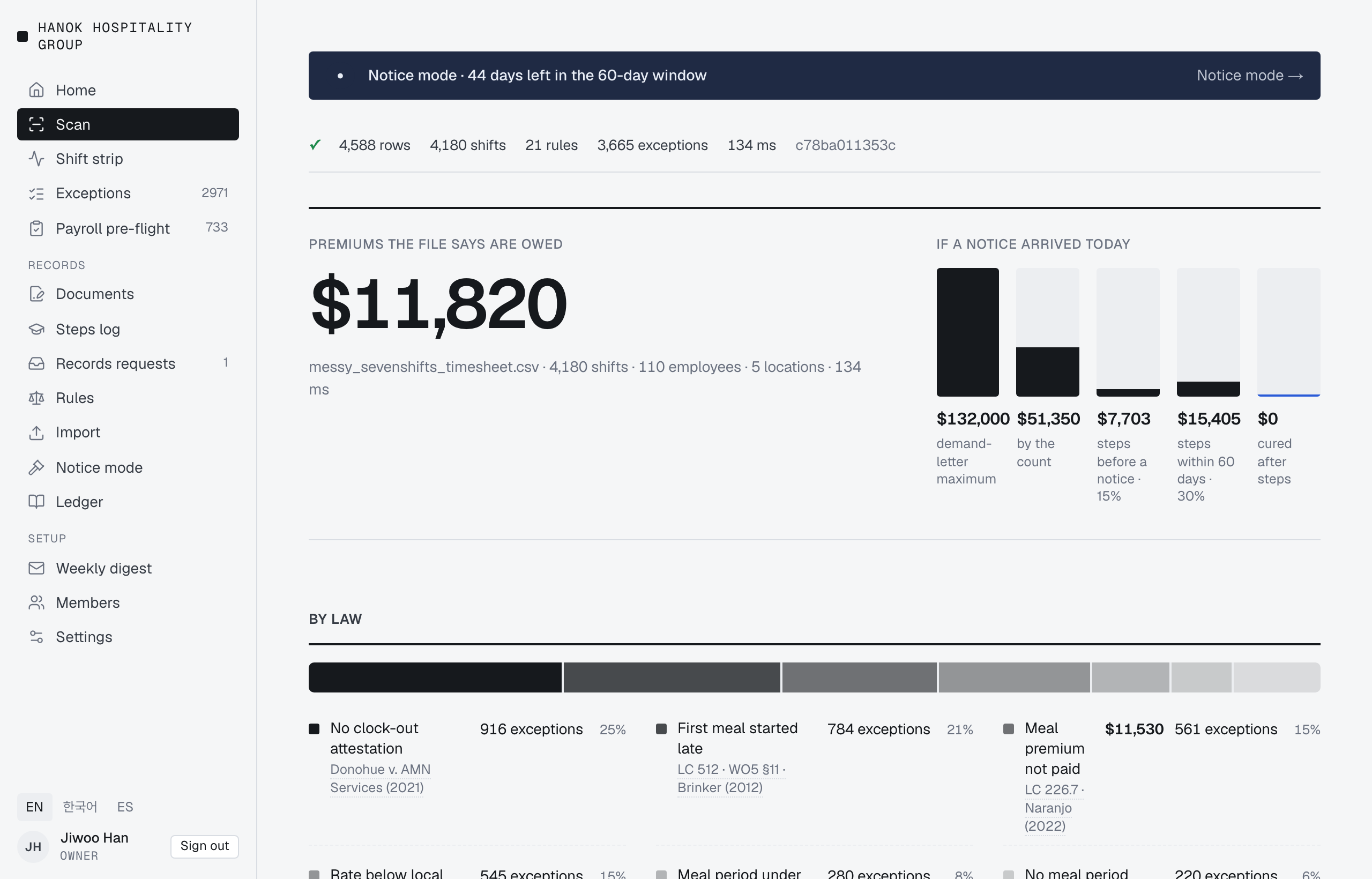
One timesheet is enough to start
A 7shifts, Toast, Square, Deputy or Homebase export, or any CSV. Twenty-one rules run; one screen shows premiums owed, the law behind each, a week-by-location map, and what a notice would turn it into.
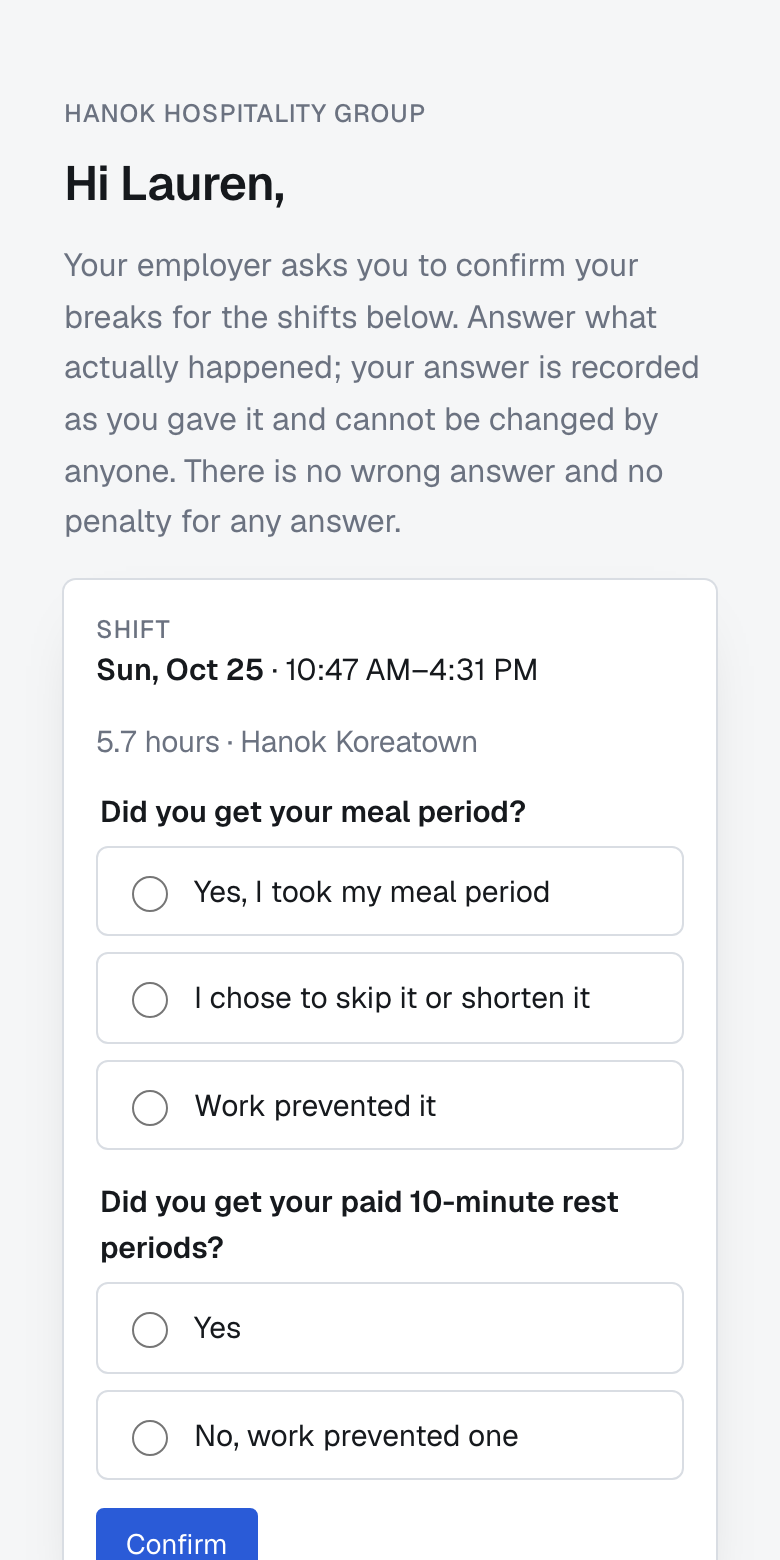
Thirty seconds, in the employee's language
On a day a meal ran late, one text. No login; the employee answers taken / I chose to skip it / work prevented it, and the answer lands in the ledger as given. Voluntary closes it; otherwise the premium goes to payroll.
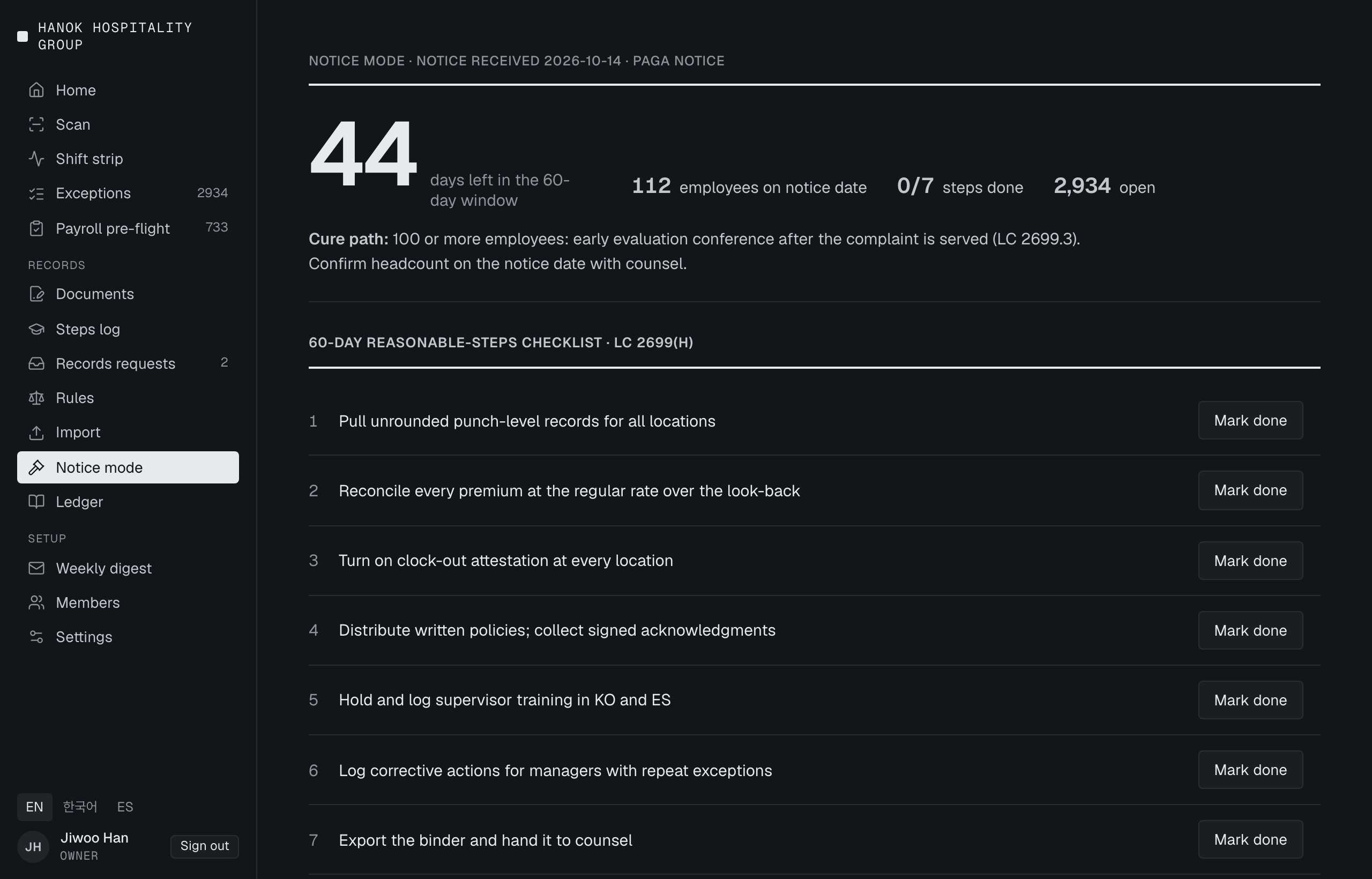
When the letter comes, a 60-day record
Photograph the notice: sections, theories and deadlines are read, and the same account becomes days-left, a checklist, a binder by theory and read-only access for counsel. The ledger is a hash chain; no line can be edited.
Your clock says a break was missed. We look at what happens next.
Clock
Tells you a break was missed, then stops. Never sees the pay stub.
Payroll
Has a premium code but never sees the break record.
Law-firm audit
Precise, once. The months in between are empty.
Fifth Hour
Cross-checks breaks against stubs and builds evidence weekly.
| Clock | Payroll | Law firm | Fifth Hour | |
|---|---|---|---|---|
| Detects meal and rest exceptions | ✓ | – | ✓ | ✓ |
| Checks the premium reached the stub | – | – | ✓ | ✓ |
| At the regular rate, bonuses included | – | – | ✓ | ✓ |
| Collects clock-out attestations | ✓ | – | – | ✓ |
| Evidence quality: rounding, waiver rates | – | – | ✓ | ✓ |
| 21/30-day records-request countdown | – | – | – | ✓ |
| Hashed ledger + 60-day notice binder | – | – | – | ✓ |
| Every pay period, Korean and Spanish | – | – | – | ✓ |
Vendor documentation as of 2026-11-01. You keep your clock and payroll; this sits on top.
The first 90 days. Ten restaurant groups in LA and Orange County.
$13 a day · less than one missed-meal premium (an hour of pay)
- Weekly exception report and premium reconciliation
- Employee attestations by text, three languages
- Signed policies and supervisor-training log
- Records-request response log
- Notice mode and the binder
- Built to work alongside your employment counsel
$2,300 per location · every pay periodwhat one location leaks in premiums in the sample file. Set that against $400 a month.
Month to month after 90 days. The ledger and binder exports are yours at any time. hello@fifthhour.co
In week one we sit down with each group's employment counsel to set it up. That is why cohort 1 stops at ten; after that, the cohort-2 waitlist.
Price sources: consultant audit range from a California HR consultant's public rate card; 7shifts from its Nov 2026 pricing page; the retainer from a San Diego owner's public account; settlements from public cases.
We never say "violation"
Exception, evidence present or missing, premium queued. Legal conclusions belong to counsel.
We do not sell immunity
Notices can still arrive. What we make is the record you hand your lawyer that day.
Numbers come only from your data
Exposure is statutory arithmetic, never a prediction.
Keys are never stored
Clock API credentials live only in the server environment. Originals are kept write-once with their hashes.
One timesheet. See it today.
Look around the sample first. Your file changes nothing until you accept.